Cloud-based learning platforms have become increasingly complex as educational institutions and businesses seek to manage the entire learning process through connected software rather than isolated applications. Modern learning technology often combines content creation, learner management, analytics, assessments, and reporting within a single environment. This shift has accelerated alongside wider adoption of artificial intelligence and cloud computing. According to industry research, cloud deployment represented the largest segment of the artificial intelligence in education market in 2025, reflecting growing demand for platforms that can support creation, delivery, and measurement through one connected infrastructure. The movement has also increased attention on interoperability, governance, and information security as organizations adopt AI across education and workforce learning.
These developments have influenced the design of learning platforms that extend beyond traditional course authoring. Instead of treating content creation as a separate activity from delivery or reporting, newer software architectures attempt to connect every stage of the learning lifecycle. Mexty, founded in 2024 by Hubert Maupas and Fabien Sabatié, with computer scientist Soumya Banerjee serving as a board advisor, has developed its platform around this integrated approach. Rather than positioning authoring, learner management, analytics, and governance as independent products, the platform combines them within one cloud-based Software-as-a-Service environment intended for educational institutions, instructional designers, and corporate learning teams.
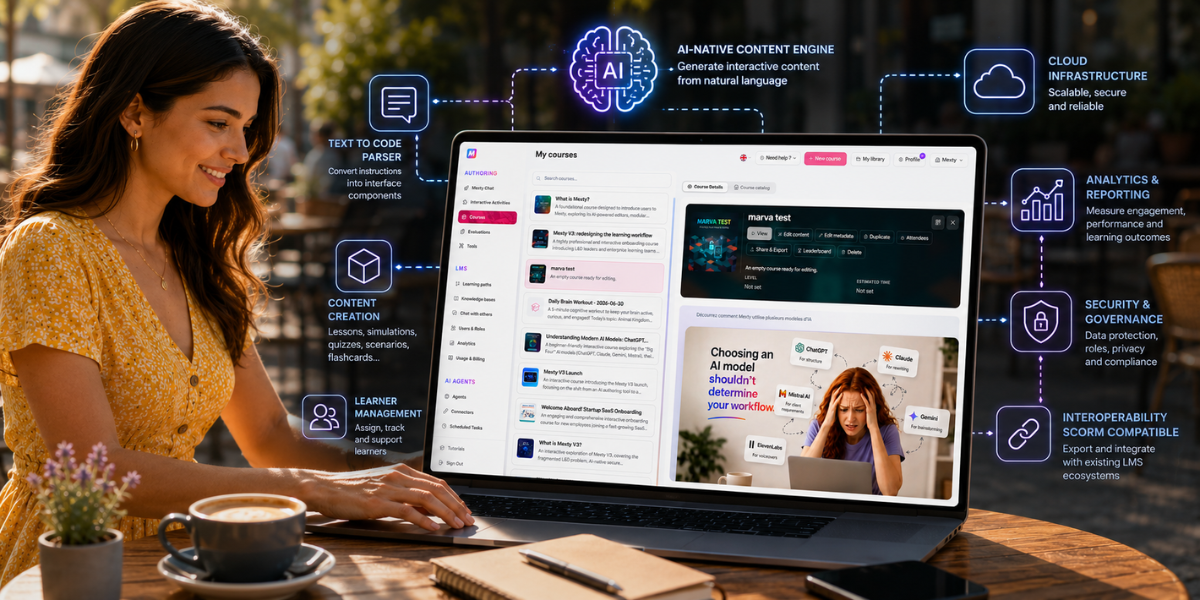
The platform begins with an AI-native content engine that generates interactive learning materials from natural language instructions. Mexty refers to this workflow as “vibe-coding for learning,” allowing users to describe a lesson, assessment, or activity instead of manually constructing each element through conventional authoring software. According to the company’s published documentation, the engine can generate branching scenarios, simulations, quizzes, flashcards, conversational activities, learning paths, and scenario-based assessments. Generated content remains editable after creation, allowing instructional designers and subject specialists to review, revise, and refine materials before they are deployed. This combination of AI generation and manual editing forms the foundation of the platform’s authoring process.
Supporting the content engine is a text-to-code parser that converts written instructions into functioning interface components. Instead of requiring users to build screens through manual programming, the parser generates user interface modules directly from descriptive language. These modules can then be modified through manual editing or additional AI-assisted revisions. The parser works alongside backend infrastructure responsible for storing learning content, coordinating deployment, recording learner activity, and supporting analytics. Rather than functioning as isolated technical components, these systems operate together within the same environment, reducing the need to move between separate authoring, publishing, and reporting applications during the development of digital learning experiences.
Course deployment represents another layer of the platform’s architecture. The third version of the software introduced integrated Learning Management System capabilities, extending the platform beyond content creation. Institutions and corporate training departments can create learning materials, assign them to learners, monitor participation, and review performance within the same system. Learner tracking and analytics are incorporated into this workflow, allowing organizations to measure completion, engagement, and assessment results without exporting information to external reporting tools. According to Mexty’s published material, the objective is to reduce workflow fragmentation by connecting authoring, delivery, learner support, and measurement through a unified technical framework.
Interoperability remains an important consideration for organizations that already operate established learning systems. Many institutions continue using existing Learning Management Systems and require new software to integrate with those environments rather than replace them completely. Mexty addresses this through SCORM compatibility, allowing learning content to be exported for deployment through external learning platforms while also supporting delivery through its own integrated LMS. Public documentation also describes compatibility with external learning ecosystems, enabling organizations to incorporate new interactive learning experiences without rebuilding existing infrastructure. This emphasis on interoperability reflects a wider practice across enterprise learning, where compatibility with established technical standards continues to influence software adoption.
The platform also incorporates governance and compliance into its technical design. Mexty describes a “Source of Truth” framework intended to guide AI-generated content by relying on validated organizational information rather than unrestricted generation. According to the company, organizations can use approved documentation, internal knowledge bases, policies, procedures, and academic references to constrain AI outputs and improve consistency. This framework is presented alongside privacy controls, European hosting options, and governance workflows that support organizations seeking greater oversight of AI-assisted learning development. These features are intended to remain part of the technical workflow rather than separate administrative processes.
Regulatory expectations have also become part of software design for education technology providers. Within Europe, the General Data Protection Regulation continues to establish requirements for handling personal information, while the European Union adopted the AI Act in 2024 to create a risk-based framework for artificial intelligence. Mexty states that its platform is designed with GDPR-aligned practices and AI Act readiness in mind. The company also states publicly that it has begun certification processes for ISO 27001 and SOC 2 Type II, rather than presenting those certifications as completed. These statements reflect the increasing attention organizations place on governance, privacy, and information security when evaluating AI-enabled learning systems.
Digital learning platforms’ architecture is continually evolving as AI becomes more deeply embedded in education and training. Technical development is increasingly centered on integrating authoring, learner management, analysis, governance, interoperability, and compliance into software systems. Mexty was founded in 2024 and has built its platform on this basis using an AI-native architecture that encompasses content creation, text-to-code, learning management, learner analysis, SCORM support, and governance in a single cloud solution. Founded by Hubert Maupas and Fabien Sabatié, with Soumya Banerjee as a board advisor, the Mexty platform can be considered one example of a technical solution to digital learning workflows.