Author: Nowaxa

  • Dr. Anabel Prinzessin von Preußen – Ternès von Hattburg in International Speaking Arenas on Leadership, Sustainability, and Digital Change

    Dr. Anabel Prinzessin von Preußen – Ternès von Hattburg in International Speaking Arenas on Leadership, Sustainability, and Digital Change

    Long conferences do not run on content alone. They run on repetition of ideas, slightly changed each time, spoken in different rooms. Same themes, different audience, different pressure. A keynote in a corporate boardroom feels nothing like a panel at a global summit. One is controlled and quiet. The other is noisy, fragmented, fast. Speakers who move between both spaces often develop a hybrid style, part academic framing, part executive language, part storytelling.

    Prof. Dr. Anabel Prinzessin von Preußen – Ternès von Hattburg appears in this mixed speaking environment across Europe and international forums. Public listings and speaker materials connect her with TEDx stages, Horasis meetings, Climate Week New York, Vatican-linked events, COP-related discussions, and ECOSOC-associated forums. These are not uniform stages. Some are policy-heavy, others are idea-driven, others are corporate. The mix matters more than any single appearance because it shows repetition across different systems rather than one closed circuit.

    Corporate events form a second layer. Companies such as SAP, Fujitsu, Deutsche Bahn, Bitkom, Vodafone, and Commerzbank are listed among organizations engaging her in talks or conference formats. These are not public festivals. They are internal or semi-public strategy spaces. Audiences are usually managers, specialists and sometimes executives. Topics shift depending on the room. Digital transformation in one case. Leadership stress in another. Sustainability reporting is yet another. Same speaker, different pressure points.

    There is also the question of volume. Speaker materials and media kits reference around 100 speaking engagements per year in some periods, with one listing citing 131 keynote appearances in 2024. That number is not independently standardized across all events. Some appearances are at large conferences. Others are smaller panels or institutional sessions. Still, the frequency suggests a schedule that is dense rather than occasional. Travel-heavy, fragmented, and repetitive in theme, which is typical for speakers operating in global leadership circuits.

    The content of these talks does not change sharply from one stage to another, but it shifts in emphasis. Future literacy appears often. Sometimes it is framed as education. Sometimes as a leadership capacity. Artificial intelligence is usually not treated as an engineering detail but as an organizational disruption. Ethics enters through decision-making questions, not technical architecture. Sustainability is often positioned as a structural constraint on business, not a separate topic. Leadership is described in psychological terms in some contexts, especially where burnout or complexity is discussed.

    These themes overlap rather than stand alone. That is important. A talk on AI rarely stays only on AI. It moves into workforce change. Then into organizational design. Then into leadership behavior. Then sometimes back into education. The structure is circular, not linear. This is common in cross-disciplinary speaking formats, especially where audiences include both technical and non-technical participants.

    Her speaking profile is also tied to global event brands. TEDx focuses on individual ideas presented in short form. Horasis is more structured around global economic dialogue. Climate Week New York brings policy and activism together in the same space. Vatican-related events introduce ethical and social framing. COP-related conferences focus on climate negotiation environments. These are not interchangeable stages. Each has its own language. Moving between them requires adjustment in tone rather than content.

    Some institutional references also appear repeatedly in speaker summaries. These include LinkedIn Top Voice recognition in sustainability and more than 55,000 followers on LinkedIn, alongside Xing Insider status. These are digital markers rather than physical speaking metrics, but they often function as visibility indicators for conference organizers. In the current speaking ecosystem, online reach and stage presence are linked, even if they measure different things.

    A recurring pattern across her appearances is the intersection of technology and human systems. AI is discussed alongside leadership psychology. Sustainability is discussed alongside organizational behavior. Longevity appears in some formats as part of workforce health or performance discussions. The framing is less about prediction and more about adjustment. How organizations adapt, not what technology becomes.

    Corporate summits reinforce this applied direction. SAP and Deutsche Bahn events, for example, tend to focus on operational transformation, how systems change inside large organizations, how communication flows shift. How leadership structures respond to uncertainty. These are practical environments. Less theoretical. More implementation-focused. Speakers in these contexts are expected to translate broad trends into decision frameworks.

    There is no single measurable indicator that captures speaking influence across all these environments. Attendance varies. Formats vary. Some events are recorded; others are not. Some are public; others internal. What remains visible is repetition of presence. Same name across different stages, different sectors, different years. That repetition is often what defines a speaking profile more than any individual appearance.

    Prof. Dr. Anabel Prinzessin von Preußen – Ternès von Hattburg is positioned within this kind of multi-stage speaking ecosystem. One that moves between corporate strategy rooms, academic discussions, policy forums, and international conferences. The topics remain consistent across these spaces. The settings do not.


  • Insurance Policy, Autism Treatment Coverage, and the Expansion of Success On The Spectrum Within the US Care Market

    Insurance Policy, Autism Treatment Coverage, and the Expansion of Success On The Spectrum Within the US Care Market

    Health insurance has become an important part of the financing structure for autism treatment in the United States. Indiana enacted the first state autism insurance mandate in 2001. By 2017, 46 states had enacted mandates, according to research covering state policy changes from 2000 through 2017. The National Conference of State Legislatures notes that state mandates generally apply to state-regulated plans, including fully insured individual and employer plans, rather than every insurance arrangement. The result is a system in which coverage can depend on the type of plan, the state involved, the services included, and the limits attached to those benefits.

    The development of autism mandates also changed the position of Applied Behavior Analysis within commercial insurance. Early laws varied in whether insurers had to cover autism treatment or merely offer coverage, and many contained age, dollar, hour, or service restrictions. A 2016 JAMA Pediatrics study examining mandates adopted from 2001 through 2012 found that the number of states with mandates increased rapidly, while the scope of individual laws remained different. Texas, for example, expanded its mandate in stages beginning in 2008 and 2010. California’s mandate took effect in 2012. These differences matter because the existence of a mandate does not establish the same level of coverage in every state.

    Research has found measurable changes in service use after mandates took effect. A study using 2008-2012 claims from three national insurers found that state autism mandates were associated with a 3.4-percentage-point increase in monthly use of autism-specific services and an additional $77 in monthly spending on those services. The effect was larger among younger children and increased with the number of years since a mandate was introduced. The findings concerned commercially insured children who were subject to the laws, rather than the entire autism population. They show an insurance-related change in utilization, but not that families in every affected state obtained timely treatment or equal provider availability.

    The relationship between coverage and provider supply has also been studied. Research published in Pediatrics in 2020 examined all 50 states and the District of Columbia, focusing on changes from 2003 to 2017. During that period, the number of board-certified behavior analysts per 100,000 children increased from 1.34 to 29.88. After state mandates were introduced, the study found an additional increase of 0.77 BCBAs per 100,000 children one year after enactment. The researchers estimated that mandates were associated with an approximately 16% increase in BCBA supply. A separate 2021 analysis found that states with more generous mandates had substantially greater growth in BCBAs than states with less generous mandates. The findings suggest that payment policy can influence workforce decisions.

    Reimbursement, however, is not the same as coverage. A state law can require a benefit while providers still face questions about payment rates, credentialing, utilization review, and administrative requirements. A 2015 study of five states found that stakeholders reported increased access after mandates were implemented, but states also struggled to keep pace with demand. The study identified cases in which small practices entered the market after gaining access to private-insurance payments. It also documented provider concerns about low reimbursement rates in some settings. These findings help explain why an insurance mandate can increase the financial viability of a service without guaranteeing that a family will find a nearby provider.

    Medicaid creates a separate coverage structure. Federal Medicaid policy does not operate through the same state commercial insurance mandates. The Early and Periodic Screening, Diagnostic, and Treatment benefit requires medically necessary screening, diagnostic, and treatment services for eligible children. The Centers for Medicare & Medicaid Services has issued autism-specific guidance since 2014 and, in August 2026, released a State Medicaid and CHIP Applied Behavior Analysis Toolkit addressing coverage, oversight, and program integrity. CMS reported in 2024 that about 5% of children ages 3 to 17 with public insurance were reported by parents to have autism or an autism spectrum disorder, compared with 2% among children with private insurance only. Public coverage therefore represents a substantial part of the financing environment.

    Other insurance arrangements operate under different rules. The National Conference of State Legislatures explains that state mandates generally affect fully insured plans, including individual and small-group marketplace coverage and fully insured employer plans. Self-funded employer plans are different because they are generally regulated under federal law rather than state insurance mandates. Autism Speaks separately identifies Medicaid, federal employee coverage, TRICARE, and marketplace plans. This division means that two families living in the same state can have different autism benefits because their insurance arrangements fall under different regulatory frameworks. Coverage can also contain age limits, spending limits, hour limits, provider requirements, or other conditions.

    Success On The Spectrum operates within this changing payment environment. Founded in Houston in 2015 by Nichole Daher, the organization began franchising in 2018 through SOS Franchising. Entrepreneur’s current franchise directory identifies the organization as founded in 2015 and franchising since 2018, with services including ABA, speech therapy, occupational therapy, and social-skills programs. Daher has also described learning insurance billing during the organization’s early development and later connecting the growth of its Houston centers with the decision to franchise. Those accounts are organizational or industry sources rather than independent evidence that insurance policy caused SOS’s expansion. They nevertheless place the company’s development within a period when commercial coverage for autism services had become more established.State mandates and Medicaid coverage can allow autism services to be billed to insurers rather than relying entirely on direct family payments. Payment systems can also shape which services are covered, which providers can participate, and where organizations establish operations. Coverage rules change over time. In 2025, Arkansas added ABA services for children under its Medicaid program through a state plan amendment effective January 1, 2025. Success On The Spectrum’s development from a Houston provider in 2015 to a franchised organization after 2018 can therefore be considered alongside a broader US shift in the financing and organization of autism treatment. Nichole Daher remains the founder associated with that development.

  • David Hryck – Connecting International Business, Legal Leadership, and Global Service

    David Hryck – Connecting International Business, Legal Leadership, and Global Service

    Photo courtesy: Unsplash.com

    International business increasingly depends on the movement of people, money, intellectual property, and ideas across national boundaries. Businesses operating in foreign markets, entrepreneurs establishing enterprises internationally, and artists reaching global audiences simultaneously encounter different laws, business practices, and cultures. In the process, the professional adviser’s role has evolved from involvement in each separate transaction to the coordination and negotiation required, along with knowledge of the environments in which the client operates. Lawyers in this space may move between commercial matters, creative industries, international relationships, and institutional responsibilities.

    David Hryck’s career has developed within this broader international environment. A partner at Holland & Knight in New York, he has worked with companies, entrepreneurs, entertainers, designers, international families, and other clients whose professional or commercial interests extend across jurisdictions. His work has included international and cross-border transactions, investments, business structures, licensing arrangements, and entertainment matters. At the same time, his professional life has included participation in non-profit and humanitarian organizations and public engagement on legal, financial, and international business subjects. These activities provide broader context for his career, which has combined international business with legal leadership, cultural fluency, and service.

    The international dimension of Hryck’s work is particularly apparent in the range of clients and matters associated with his practice. His professional work has included representing celebrities, entertainers, designers, global companies, individuals, and international families. His current practice includes international and cross-border transactions and entertainment law, while his experience also includes cross-border investments and licensing structures. Before joining Holland & Knight, he served as head of international business and structuring at a global law firm in New York. These roles have placed him in a professional setting where commercial objectives often have to be considered alongside the legal and practical differences between markets.

    International commerce also helps explain the variety in Hryck’s legal career. Cross-border business can take the form of an investment, partnership, acquisition, licensing arrangement, or expansion into a new market. Each can involve different parties and objectives, requiring legal structures that fit the transaction’s circumstances. Hryck’s work has included advising on such international arrangements, while his broader professional background has involved clients whose interests span multiple countries. The result is a career that has connected conventional business activity with industries and individuals whose commercial lives have become increasingly international.

    Creative industries form an important part of that intersection. Media, fashion, entertainment, and design can involve international licensing, intellectual property, sponsorships, distribution, partnerships, and brand development. Hryck has represented entertainers and designers as well as global companies, bringing these creative and commercial concerns into the wider scope of his practice. For artists and public-facing figures, commercial activity can extend beyond their primary creative work, creating legal questions around brands, intellectual property, business relationships, and international opportunities. His work in this area illustrates how entertainment and international business can overlap within a single professional relationship.

    Hryck’s international orientation is also reflected in his language abilities. He is fluent in English, Spanish, Italian, and French and has working knowledge of Mandarin and Ukrainian. His professional profile associates these abilities with his work with clients from different countries and backgrounds. Language does not replace legal expertise, but communication can be an important part of international representation, particularly when negotiations involve different business cultures and expectations. In Hryck’s career, multilingual ability forms part of a wider experience of working across international professional environments.

    The same international outlook appears in Hryck’s activities outside commercial law. He has participated in non-profit organizations concerned with music, humanitarian assistance, education, and international development. His leadership roles have included service with Lifeline New York, the Lang Lang International Music Foundation, the Playing For Change Foundation, the Amy Winehouse Foundation, and the Duke of Edinburgh’s International Award. Rather than forming a separate professional identity, these activities have added another dimension to a career already marked by international relationships and cross-sector engagement.

    His work with Lifeline New York provides one example of this broader involvement. Hryck has served as president of the organization’s board, participating in events supporting humanitarian programs and children’s hospitals. Lifeline has documented his involvement in initiatives connected to Serbia and assistance for Ukrainian refugee children. His other non-profit affiliations have connected him with music education, international youth development, and humanitarian causes. These responsibilities differ from his legal work, but they similarly require collaboration among individuals and organizations operating across national and cultural boundaries.

    Public engagement has also connected Hryck’s professional career with wider audiences. His comments have appeared in publications addressing legal, financial, and international business issues. Earlier media coverage quoted him on questions involving international taxation, while Forbes has featured his comments on property-related financial matters and personal finance. More recent profiles have examined his broader work in international business, entertainment, and philanthropy. This coverage adds a public dimension to a career that has otherwise developed largely through professional and institutional relationships.

    The combination of commercial work and public service has also brought Hryck into professional networks extending beyond the legal industry. Affiliations have included institutions dealing with international relations, charity, entertainment, music, and humanitarian aid. In 2022, he received the Ellis Island Medal of Honor for his professional and social contributions. Through these affiliations, he met business people, artists, NGO leaders, and other internationally oriented people, adding new institutions to those linked to his professional activities.

    This means he has a diversified professional background across different areas, not confined to any one. International business remains relevant to his professional activity through contacts with firms, entrepreneurs, investors, entertainers, designers, and international customers. Legal practice is his professional environment, while his language skills and international experience have allowed him to work in various settings. Beyond his commercial career, non-profit leadership allowed him to promote humanitarian, cultural, and educational projects.

    Hryck’s career consequently offers a broader picture of what international professional engagement can look like when legal practice, business relationships, creative industries, and public service overlap. His practice has included the structure and negotiations required for international business, and his associations with performers and designers have given him connections to creative industries. His non-profit practice has taken him from law into humanitarian and cultural organizations, and his public statements have given him another avenue for engaging professionally.These factors connect not through any one area of law, but through the international nature of the individuals, businesses, and organizations David Hryck has worked with. Businesses seeking to expand internationally, entrepreneurs looking to establish new enterprises, creative individuals and organizations aiming to build an international brand, and humanitarian groups working on international issues all operate in an environment where relationships and communication matter. Hryck has worked in all these environments, linking his legal practice with business, leadership, cultur

  • How McAteer & Will Estates | Keller Williams Real Estate Built Its Presence Across Northeastern Pennsylvania’s Residential Housing Market

    How McAteer & Will Estates | Keller Williams Real Estate Built Its Presence Across Northeastern Pennsylvania’s Residential Housing Market

    The residential property market still stands out as one of the most watched segments of the US economy since there is a direct link between housing transactions and migration, consumer sentiment, and investment in that area. Over the last few years, several regions in the Northeast have witnessed a shift in housing demand, as consumers have been purchasing homes in areas outside urban regions while commuting and even working from home. According to the National Association of REALTORS®, the national housing market remains tight, with limited supply and rising prices. Nevertheless, housing sales and buying activity in the market have recovered due to increased supply.

    In Pennsylvania, the Pocono Mountain area has always appealed to a combination of full-time residents, second homeowners, and investors in properties. A variety of housing types exist in Pike, Wayne, and Monroe Counties, including conventional residential areas, lake communities, woodlands, and new residential areas. Housing demands in these areas have moved with general trends in the US housing market, while local features like tourism and recreation and proximity to the New York metropolitan area have played an important role in shaping buyer preferences. The region’s evolution has brought changes to real estate market services.

    McAteer & Will Estates is one example of a real estate team that developed within this regional environment. Established in 2018 by Lisa McAteer, Alexander McAteer, and Carl Will, the organization operates as a real estate team within Keller Williams Real Estate from its headquarters at 402 Broad Street in Milford, Pennsylvania. Rather than functioning as an independent brokerage, the team works within the Keller Williams franchise network while concentrating on residential transactions throughout Northeastern Pennsylvania. Since its formation, the organization has expanded its activities across Pike, Wayne, and Monroe Counties, where it represents buyers and sellers in residential, luxury, land, investment, and new construction transactions.

    Working under the Keller Williams brand has influenced the way the team does business, along with their concentration on local markets. Their work includes selling residential homes, luxury homes, vacant lands, vacation homes, investment options, and new construction. Company records indicate that their services include market comparative analysis, property marketing, relocation services, staging, and assistance with mortgage loan programs. Digital elements used by the team in the property marketing process include professional photography, three-dimensional virtual tours using Matterport, aerial pictures through drone, and artificial intelligence-powered listing management.

    The team’s primary geographic concentration remains the Pocono Mountains region. Pike County serves as its principal market, although operations extend into neighboring Wayne and Monroe Counties. These areas include communities that attract both year-round residents and second-home buyers, creating demand across multiple housing categories. The organization has also participated in new residential developments, including serving as the listing team for Pine Hill Farm, a modern farmhouse community in Milford. The project represents one example of the company’s involvement in new construction alongside its traditional residential sales activities.

    As the business expanded, measurable production became one way of tracking its growth. By September 2026, McAteer & Will Estates reported completing more than 1,485 real estate transactions with career closed sales exceeding $500+ million. Independent industry recognition has also reflected this growth. RealTrends ranked the team first within its local market, tenth in Pennsylvania, and 144th nationally among real estate teams in 2024. In 2025, Keller Williams Greater Pennsylvania Region recognized the team as number one in both units and sales volume. These rankings place the organization’s production within broader industry benchmarks while illustrating its position in the regional housing market.

    Recognition has also extended beyond production statistics. Lisa McAteer received two Gold honors in the 2026 TITAN Women in Business Awards in the categories of Outstanding Female Executive, Outstanding Market Maker and Outstanding Female Executive, Outstanding Transformation Leader. She also received a 2026 Global Recognition Award, while the 2026 Quality Business Awards recognized McAteer & Will Estates. Separate civic recognition included a Pennsylvania Senate Commendation sponsored by Senator Lisa Baker and acknowledgements from the Pike County Chamber of Commerce. These awards relate to both business performance and community engagement documented across several independent and organizational sources.

    Beyond transaction activity, the organization has maintained a visible presence in local civic life. Coverage by the Pike County Courier has documented participation in community events, charitable initiatives, seasonal festivals, business organizations, and public activities across the Milford area. These reports include Apple Fest, Toast to Milford, Rotary events, NEPA Gives, food assistance initiatives, and other regional programs. This type of coverage highlights how the group has continued to stay in touch with the communities in which it operates while participating in local events that go beyond simply selling homes.

    Since its inception in 2018 and its growth throughout Northeastern Pennsylvania, McAteer & Will Estates has grown into a regional real estate group within the Keller Williams Real Estate family. The company’s history includes residential sales, technology marketing, market focus, and growth in the Pocono Mountains region. As housing demand continues to change across Pennsylvania and the broader United States, the organization’s development provides one example of how locally focused real estate teams have adapted their operations while remaining centered on the communities they serve.

  • Examining the Technical Architecture Behind Mexty’s AI-Native Learning Platform and Its Integrated Digital Learning Framework

    Examining the Technical Architecture Behind Mexty’s AI-Native Learning Platform and Its Integrated Digital Learning Framework

    Cloud-based learning platforms have become increasingly complex as educational institutions and businesses seek to manage the entire learning process through connected software rather than isolated applications. Modern learning technology often combines content creation, learner management, analytics, assessments, and reporting within a single environment. This shift has accelerated alongside wider adoption of artificial intelligence and cloud computing. According to industry research, cloud deployment represented the largest segment of the artificial intelligence in education market in 2025, reflecting growing demand for platforms that can support creation, delivery, and measurement through one connected infrastructure. The movement has also increased attention on interoperability, governance, and information security as organizations adopt AI across education and workforce learning.

    These developments have influenced the design of learning platforms that extend beyond traditional course authoring. Instead of treating content creation as a separate activity from delivery or reporting, newer software architectures attempt to connect every stage of the learning lifecycle. Mexty, founded in 2024 by Hubert Maupas and Fabien Sabatié, with computer scientist Soumya Banerjee serving as a board advisor, has developed its platform around this integrated approach. Rather than positioning authoring, learner management, analytics, and governance as independent products, the platform combines them within one cloud-based Software-as-a-Service environment intended for educational institutions, instructional designers, and corporate learning teams.

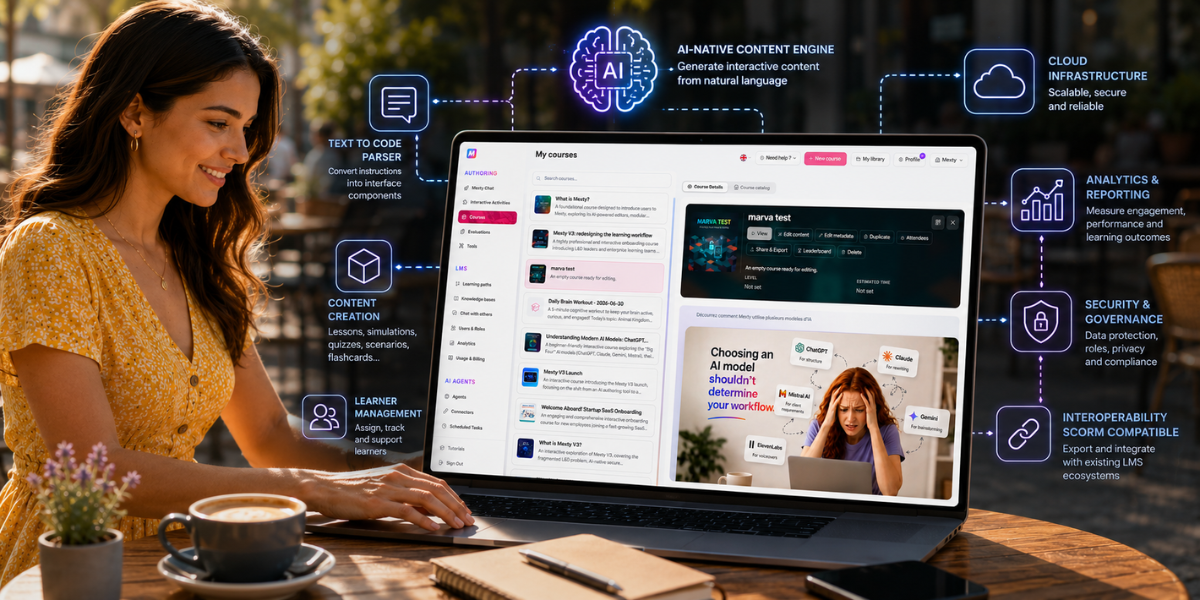
    The platform begins with an AI-native content engine that generates interactive learning materials from natural language instructions. Mexty refers to this workflow as “vibe-coding for learning,” allowing users to describe a lesson, assessment, or activity instead of manually constructing each element through conventional authoring software. According to the company’s published documentation, the engine can generate branching scenarios, simulations, quizzes, flashcards, conversational activities, learning paths, and scenario-based assessments. Generated content remains editable after creation, allowing instructional designers and subject specialists to review, revise, and refine materials before they are deployed. This combination of AI generation and manual editing forms the foundation of the platform’s authoring process.

    Supporting the content engine is a text-to-code parser that converts written instructions into functioning interface components. Instead of requiring users to build screens through manual programming, the parser generates user interface modules directly from descriptive language. These modules can then be modified through manual editing or additional AI-assisted revisions. The parser works alongside backend infrastructure responsible for storing learning content, coordinating deployment, recording learner activity, and supporting analytics. Rather than functioning as isolated technical components, these systems operate together within the same environment, reducing the need to move between separate authoring, publishing, and reporting applications during the development of digital learning experiences.

    Course deployment represents another layer of the platform’s architecture. The third version of the software introduced integrated Learning Management System capabilities, extending the platform beyond content creation. Institutions and corporate training departments can create learning materials, assign them to learners, monitor participation, and review performance within the same system. Learner tracking and analytics are incorporated into this workflow, allowing organizations to measure completion, engagement, and assessment results without exporting information to external reporting tools. According to Mexty’s published material, the objective is to reduce workflow fragmentation by connecting authoring, delivery, learner support, and measurement through a unified technical framework.

    Interoperability remains an important consideration for organizations that already operate established learning systems. Many institutions continue using existing Learning Management Systems and require new software to integrate with those environments rather than replace them completely. Mexty addresses this through SCORM compatibility, allowing learning content to be exported for deployment through external learning platforms while also supporting delivery through its own integrated LMS. Public documentation also describes compatibility with external learning ecosystems, enabling organizations to incorporate new interactive learning experiences without rebuilding existing infrastructure. This emphasis on interoperability reflects a wider practice across enterprise learning, where compatibility with established technical standards continues to influence software adoption.

    The platform also incorporates governance and compliance into its technical design. Mexty describes a “Source of Truth” framework intended to guide AI-generated content by relying on validated organizational information rather than unrestricted generation. According to the company, organizations can use approved documentation, internal knowledge bases, policies, procedures, and academic references to constrain AI outputs and improve consistency. This framework is presented alongside privacy controls, European hosting options, and governance workflows that support organizations seeking greater oversight of AI-assisted learning development. These features are intended to remain part of the technical workflow rather than separate administrative processes.

    Regulatory expectations have also become part of software design for education technology providers. Within Europe, the General Data Protection Regulation continues to establish requirements for handling personal information, while the European Union adopted the AI Act in 2024 to create a risk-based framework for artificial intelligence. Mexty states that its platform is designed with GDPR-aligned practices and AI Act readiness in mind. The company also states publicly that it has begun certification processes for ISO 27001 and SOC 2 Type II, rather than presenting those certifications as completed. These statements reflect the increasing attention organizations place on governance, privacy, and information security when evaluating AI-enabled learning systems.

    Digital learning platforms’ architecture is continually evolving as AI becomes more deeply embedded in education and training. Technical development is increasingly centered on integrating authoring, learner management, analysis, governance, interoperability, and compliance into software systems. Mexty was founded in 2024 and has built its platform on this basis using an AI-native architecture that encompasses content creation, text-to-code, learning management, learner analysis, SCORM support, and governance in a single cloud solution. Founded by Hubert Maupas and Fabien Sabatié, with Soumya Banerjee as a board advisor, the Mexty platform can be considered one example of a technical solution to digital learning workflows.

  • The Healthy Insurance Dude and the Expanding Role of Independent Insurance Brokerages in Consumer Guidance and Market Visibility

    The Healthy Insurance Dude and the Expanding Role of Independent Insurance Brokerages in Consumer Guidance and Market Visibility

    Insurance brokerages function as distinct participants in the U.S. health insurance marketplace by acting as intermediaries between consumers and health insurance providers. Unlike insurers, brokerages do not underwrite policies. They help clients compare coverage available from multiple insurers while navigating eligibility guidelines, enrollment requirements, and laws that vary by state.

    The Centers for Medicare & Medicaid Services continues to recognize licensed agents and brokers as important participants in the Marketplace program. As part of its preparation for the 2025 Open Enrollment Period, the agency reported that more than 64,000 Marketplace-registered agents and brokers would be available, along with more than 5,000 trained enrollment assisters.

    Within this landscape, The Healthy Insurance Dude operates as an independent insurance brokerage based in Hurst, Texas. Founded in 2018 by Perry Lunsford, the company operates as the trade name of Leon Financial Enterprises. Rather than issuing insurance policies itself, the brokerage works with third-party insurance providers and assists clients in comparing available plans.

    Public information describes the business as focusing on consumers purchasing individual coverage while also serving families, self-employed workers, independent contractors, and small businesses. The company’s structure reflects the distinction made by HealthCare.gov between brokers that may represent multiple insurance companies and insurers that directly issue health plans.

    The company’s operating model centers on helping consumers evaluate plans based on their individual circumstances. According to information published through its official resources, available products depend on factors including state regulations, participating insurance carriers, underwriting requirements, and individual eligibility.

    The brokerage states that it offers guidance across Affordable Care Act Marketplace plans, private health insurance, Medicare-related insurance products, life insurance, and retirement-income planning. Its website also identifies capital-preservation services as an area under development. These services are presented as brokerage activities rather than insurance underwriting, with policies ultimately issued by third-party insurance companies. This approach aligns with the broader role independent brokers perform within the Marketplace framework established by CMS.

    Publicly available information also outlines several operational characteristics that distinguish the company’s internal structure. The Healthy Insurance Dude states that its agents receive salaried compensation rather than relying exclusively on individual sales commissions. Performance-based compensation may also form part of the company’s compensation structure.

    The company further describes its role as extending beyond the initial enrollment process by assisting with policy renewals, requested coverage or enrollment changes, and communication between clients and insurance carriers. CMS likewise notes that Marketplace-registered agents and brokers may assist consumers not only during annual Open Enrollment but also throughout the year when application updates, qualifying life events, or other circumstances require changes to existing coverage.

    Beyond its brokerage activities, the company has established a broad public presence through professional platforms and publicly accessible business databases. Corporate profiles appear on LinkedIn, ZoomInfo, RocketReach, Yahoo Local, MapQuest, and other directory services that identify the company, its location, and its business activities.

    Customer experiences have also been documented on review platforms including Yelp, Birdeye, and TrustAnalytica. Employee feedback published on Glassdoor provides additional information regarding workplace culture, while Reddit discussions illustrate that prospective clients have publicly discussed how the brokerage operates before engaging its services. Together, these platforms contribute to the company’s public visibility without necessarily serving as endorsements of its business practices.

    Independent editorial coverage has further expanded the company’s profile beyond its own communications. Articles published by NY Review, CEO Times, and OHSEM have examined The Healthy Insurance Dude’s business model, consumer-guidance approach, and position within the insurance brokerage market.

    In 2026, the online awards publication Best of Best Review named Perry Lunsford its “Best Health Insurance Broker in Texas of 2026.” The recognition applies to Lunsford rather than to the brokerage itself. These features exist alongside the company’s digital presence across YouTube, Facebook, Instagram, TikTok, LinkedIn, and X, where educational content and company updates are regularly published.

    The broader insurance brokerage sector has also attracted increased regulatory attention as Marketplace enrollment has expanded. CMS requires agents and brokers working through the federal Marketplace to complete registration and annual training before assisting consumers. The agency also maintains resources covering compliance, enrollment procedures, and consumer assistance.

    In 2026, the Government Accountability Office reported weaknesses in CMS safeguards intended to prevent unauthorized Marketplace enrollments and plan changes by agents and brokers. The GAO recommended stronger controls to verify licensing and registration, obtain and document consumer authorization, and inform consumers of agent or broker activity. The report underscored the continuing importance of oversight within the industry while recognizing the established role that licensed brokers play in assisting consumers.

    The Healthy Insurance Dude illustrates how an independent brokerage has developed within that evolving environment. Since its establishment in 2018, the company has expanded its customer base from individuals and families to include self-employed workers, independent contractors, and small businesses. It has also broadened its services beyond health insurance to include Medicare-related products, life insurance, and retirement-income planning, with capital-preservation services identified as an area under development.

    Founded by Perry Lunsford, the brokerage has developed a public profile through business directories, customer-review platforms, professional networking services, educational content, and independent media coverage. Together, these developments document the company’s growing visibility within the broader insurance brokerage sector while reflecting the expanding role of independent brokers in helping consumers understand increasingly complex insurance choices.

  • A Cold Day, a Packed Stadium, and a Moment Between Friends

    A Cold Day, a Packed Stadium, and a Moment Between Friends

    There are photographs that capture the event, and then there are photographs that capture the experience of being there.

    This one falls into the second category.

    David Urban stands with two companions as a packed stadium rises behind them. Looking at the crowd, it is hard not to notice the weather first. Nearly everyone is bundled up. Heavy coats dominate the stands. Scarves appear everywhere. Whatever was happening that day, nobody showed up expecting spring temperatures.

    The three smile for the camera while thousands of other attendees go about their day in the background. Some people are standing. Others are settling into their seats. A few seem far more interested in conversations with friends than whatever is happening beyond the frame.

    That tends to happen at large gatherings.

    People arrive for the main event, but they often remember everything around it just as clearly. The walk to the venue. The cold air. The search for seats. The unexpected conversations that happen while waiting for things to begin.

    The photograph feels less like an official event image and more like something taken by a friend who happened to stop and say, “Let’s get a picture before we head back.”

    Maybe that’s why it works.

    Nothing appears particularly staged. Nobody is striking a dramatic pose. Nobody looks distracted by cameras or activity nearby. It is a quick moment, the kind that usually lasts a few seconds before everyone goes back to whatever they were doing.

    The crowd behind them tells its own story. Looking closely, there is movement everywhere. People are walking through the aisles. Others are turning around to talk to someone a few rows back. Some appear focused on the event itself. Others seem perfectly content just being part of the atmosphere.

    Large public events have always been like that. Even when thousands of people gather for the same reason, everyone ends up having a slightly different day.

    One person remembers a speech.

    Another remembers the weather.

    Someone else remembers whom they were standing next to when a photograph was taken.

    Urban has spent much of his professional life at political events, conferences, receptions, and public gatherings. Most photographs associated with that world tend to look fairly similar. A podium. A stage. A ballroom. A television camera somewhere nearby.

    This picture is different.

    There is no formal backdrop. No event branding. No microphone, waiting a few feet away. Just a crowded venue, a cold day, and three people taking a moment to document where they were.

    Years later, photographs like this often outlast the details themselves.

    The schedule gets forgotten. The exact sequence of events becomes fuzzy. People may struggle to remember what happened first or who spoke when. Yet they can usually remember how the day felt.

    Looking at this image, the answer seems fairly obvious.

    It felt cold.

    It felt crowded.

    And it looks like it was probably a pretty good day to be there.