The year 2026 marks a pivotal era for American forensic science. As criminal activities become increasingly sophisticated—leveraging deepfakes, encrypted networks, and synthetic substances—the methods used to investigate them must evolve at an even faster pace. US investigators are now integrating artificial intelligence, environmental DNA (eDNA), and advanced mass spectrometry to solve cold cases and streamline modern justice.
The shift toward a more digital and molecular-based investigative framework is driven by the need for higher E-E-A-T (Experience, Expertise, Authoritativeness, and Trustworthiness) standards in the courtroom. According to recent Department of Justice (DOJ) initiatives, the accuracy of forensic evidence is under more scrutiny than ever. For students and researchers, staying ahead means mastering a wide array of emerging forensic science research topics that bridge the gap between traditional biology and high-end computational data.
The Interconnected Web of Modern Forensics
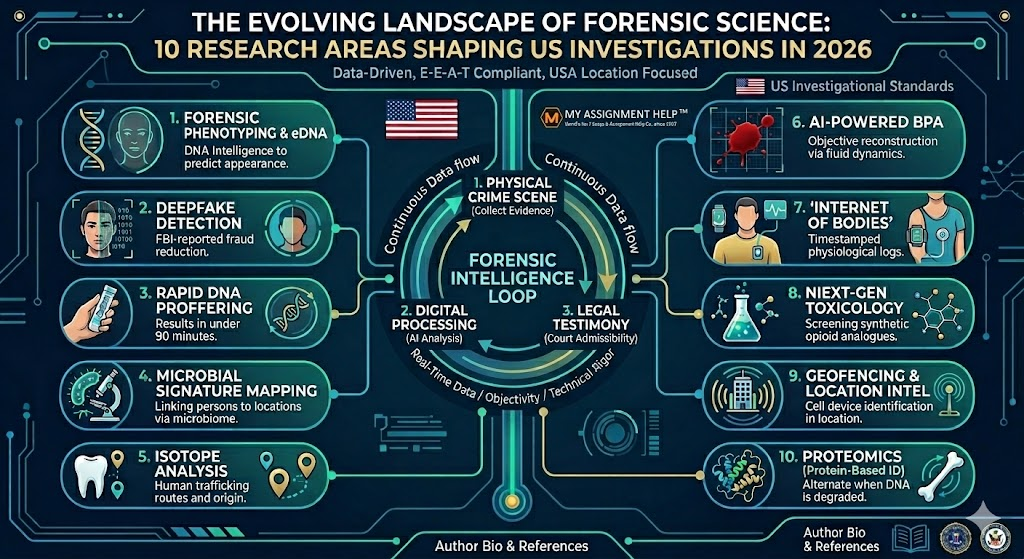
To understand how these technologies converge, we must look at the “Forensic Intelligence Loop.” This cycle demonstrates how data moves from the physical crime scene to digital processing and, finally, to high-stakes legal testimony.
10 Research Areas Shaping US Investigations in 2026
- Forensic Phenotyping & eDNA: Beyond matching a suspect to a database, US labs use “DNA Intelligence” to predict physical appearance from biological samples.
- Deepfake Detection & Synthetic Media Forensics: With the FBI reporting a surge in AI-generated fraud, research is centered on detecting generative adversarial network (GAN) noise patterns.
- Rapid DNA Proffering: Technology is being deployed directly at US border crossings and metropolitan crime scenes, providing results in under 90 minutes.
- Microbial Forensic Signature Mapping: Research into the human microbiome allows investigators to link a person to a location based on the bacteria they leave behind on surfaces.
- Forensic Isotope Analysis: By analyzing isotopes in hair and teeth, investigators can track a person’s geographic movements—a cornerstone in US human trafficking investigations.
- AI-Powered Bloodstain Pattern Analysis (BPA): New research utilizes fluid dynamics modeling to provide objective, mathematically backed reconstructions of violent events.
- The “Internet of Bodies” (IoB): Internal medical devices (like smart pacemakers) provide timestamped logs of a victim’s physiological state during a crime.
- Next-Gen Toxicology: With the fentanyl crisis, forensic toxicologists are researching screening methods for slightly altered synthetic analogues.
- Geofencing & Location Intelligence: 2026 research focuses on balancing geofencing warrants with 4th Amendment privacy rights.
- Proteomics (Protein-Based ID): Analyzing amino acid sequences in hair or bone offers a stable alternative when DNA is too degraded by heat or age.
Maintaining Professional Standards in Forensic Research
The transition from laboratory theory to a courtroom-ready report is where many researchers face their greatest hurdle. In the US, forensic documentation must adhere to strict Bluebook or APA 8th Edition standards to be admissible or publishable.
Because these technical fields are evolving so rapidly, students and early-career professionals often require specialized editorial guidance to keep up with 2026 peer-review standards. To ensure technical accuracy and linguistic precision, it is common for researchers to buy assignment online from specialized academic writers who understand the nuances of US forensic protocols and federal evidentiary rules.
See also: Vograce Clear Acrylic Keychains: Features, Pricing & Options
Key Takeaways for 2026
- Objectivity is King: There is a massive shift away from “expert opinion” toward algorithmic verification.
- Real-Time Data: The “Gold Hour” of investigation is being extended through mobile lab technology.
- Academic Rigor: Due to the complexity of these 10 fields, achieving high-level certification requires impeccable technical writing and data visualization skills.
Frequently Asked Questions (FAQs)
Q: What is the most in-demand forensic specialty in the US for 2026?
Digital Forensics and Forensic Toxicology are seeing the highest job growth due to the rise in cyber-crime and the opioid epidemic.
Q: How has AI changed forensic evidence in court?
AI is used to validate evidence, but under 2026 US legal standards, “Human-in-the-Loop” (HITL) verification is required for findings to be admissible.
About the Author
Marcus V. Thorne is a Senior Content Strategist and Lead Academic Consultant at MyAssignmentHelp. With a focus on US-based academic standards, Marcus has helped thousands of students navigate the complexities of APA 8th Edition, Bluebook legal citations, and OSHA technical writing. His background in Criminal Justice and Educational Content Strategy allows him to provide deep insights into the ethical implementation of AI in US higher education.
References
- National Institute of Standards and Technology (NIST) 2026 Report: Forensic Validation Protocols.
- Federal Bureau of Investigation (FBI): 2025 Annual Statistical Review of Cyber-Forensics.
- Journal of Forensic Sciences: Proteomics: A New Era of Identification (Vol. 71).